EC Prices Have More Than Doubled Since 2015. Now the Government Is Finally Reviewing the Policy.
Update, 28 August 2026: The review has now produced two cut-offs for future ECs. Projects whose land tender closes from 8 May 2026 get a 10-year MOP and 15-year privatisation timeline, while the $18,000 income ceiling applies only when the tender closes from 24 August 2026. Earlier projects remain under their project-specific rules. Here is the short version.
Executive condos were designed to be the affordable middle ground: private amenities, HDB pricing. That pitch has aged badly.
The median price of a new EC unit hit $1,754 psf in 2025. That’s more than double the $797 psf recorded in 2015. In the same year, the average EC unit went for $1,531 psf, which is 14 per cent higher than an HDB resale flat at $603 psf. And yet ECs are still supposed to serve as a stepping stone for Singaporeans who can’t afford private but don’t want to stay in public housing.
The math stopped working a while ago. Parliament finally caught up.
At the Committee of Supply debate on March 4, Workers’ Party MP Louis Chua put the question directly to Minister Chee Hong Tat: if EC prices have “skyrocketed,” can the authorities do something about it? Chee’s response: “We are reviewing the policy and we will consider your suggestions as part of the review.”
That’s a yes, basically.
What might change? Chee didn’t commit to specifics, but the clear pressure points are pricing (which is driven by private developers building on land sold by HDB), the income ceiling, and the Minimum Occupation Period. The current income ceiling sits at $16,000 for families, and the MOP is 5 years before an EC can be sold on the open market and 10 years before it can be sold to foreigners.
The WP also raised the 15-month wait-out period for private home owners who want to downgrade to an HDB resale flat. Chee said the restriction has been in place since September 2022, and the “recent data looks promising.” He’s watching before adjusting. A hint that it could be relaxed, but not yet.
On BTO income ceilings (separate from ECs), Chee said authorities are watching closely. If the ceiling is raised, more buyers qualify, which means more competition, which might push prices up. The trade-off is real and they’re aware of it.
One more data point worth knowing: between 2021 and 2025, 102,400 EC units were launched. That’s a lot of supply. And yet prices still went up. Which tells you something about how hot demand has been, and how sticky EC pricing is once developers set the benchmark.
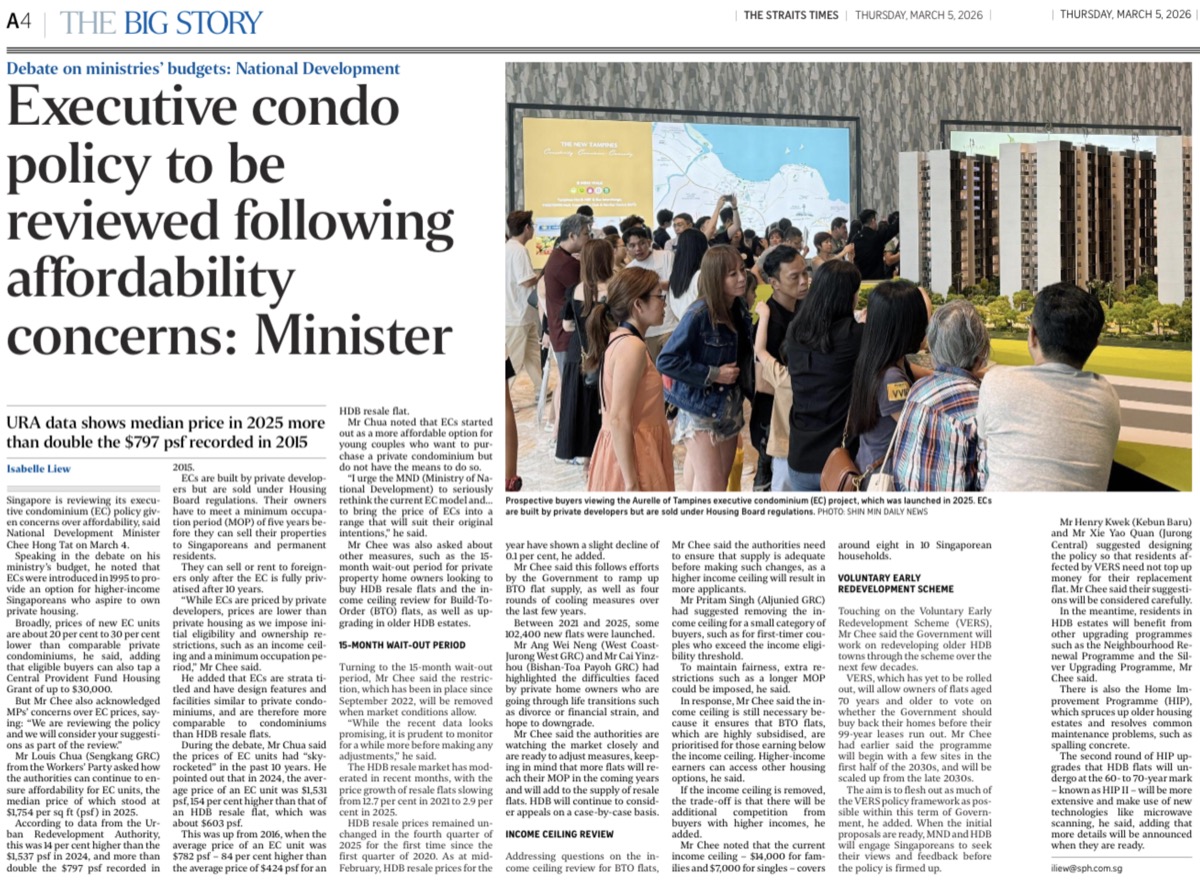
If you’re currently in the EC consideration window (household income under $16,000, at least one applicant who’s a Singapore citizen, etc.), the Aurelle of Tampines is among the recently launched ECs worth tracking. It’s in Tampines, well-connected, and reflects what the current pricing environment looks like in practice.
The policy review is underway. What form it takes, nobody knows yet. But if you’ve been priced out of ECs and feeling like the product lost its original purpose, you’re not wrong, and the government has now acknowledged it.
More updates when the review concludes.