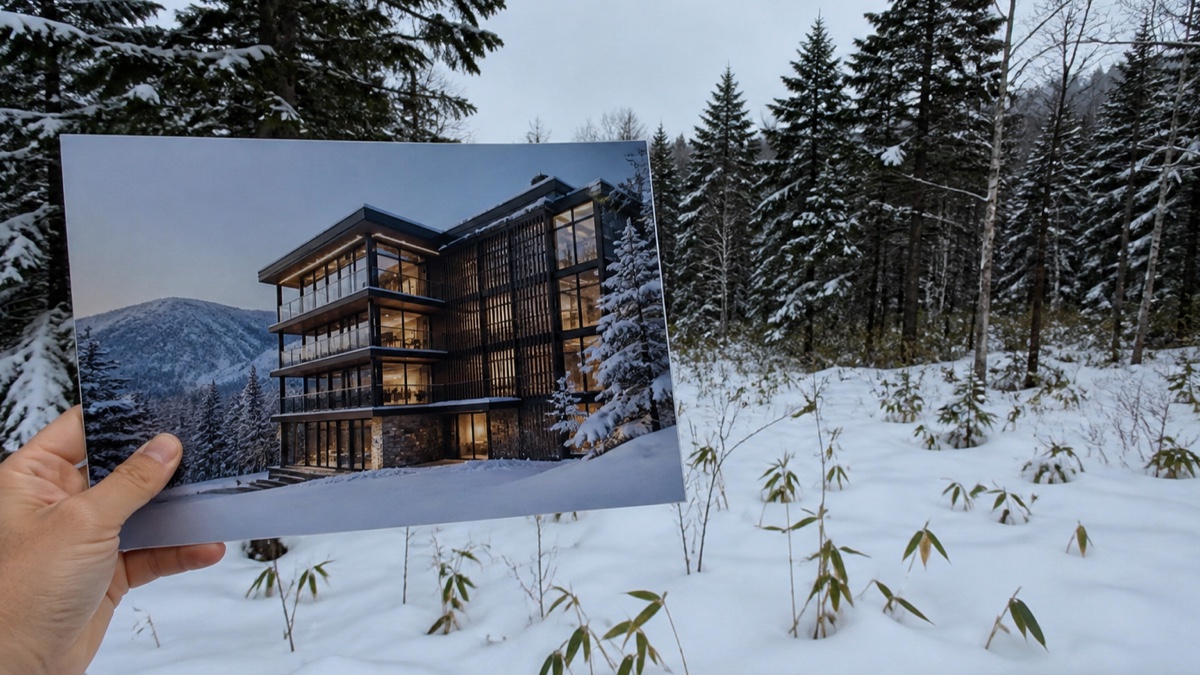
The S$2.4 Million Ski Home That Was Actually a Forest
The brochure promised a 136 sqm freehold apartment in Niseko, Japan, with completion scheduled for December 2021.
The buyer agreed to pay US$1.88 million, around S$2.4 million at the time. She eventually made six progress payments totalling US$1.786 million.
There was just one rather serious problem.
The developer did not own the land. No application had even been made for permission to start construction.
When a Japanese lawyer visited the address in 2022, the photographs showed forested land with no sign of construction. The only thing progressing nicely was the payment schedule.
The brochure had everything except land
This wasn’t an inexperienced buyer clicking on a suspicious Facebook advertisement.
She had invested in properties around the world and had worked with the same property agent since 1995. The project came with polished brochures, artist impressions, floor plans, a completion date and a detailed payment schedule.
But documents created by the seller aren’t independent proof.
The High Court found in 2025 that false representations had been made about the developer owning the land and intending to begin construction soon. The Singapore seller was ordered to pay US$1.786 million in damages with interest.
In June 2026, the Appellate Division upheld the fraudulent misrepresentation finding and damages award.
The court did not uphold every finding made below. In particular, it found insufficient evidence that the seller had created artificial urgency or discouraged the buyer from appointing a Japanese lawyer.
The fraud finding survived anyway because the most important representations went to the heart of the deal: Did the developer own the land, and could this project actually be built?
The answer to both was no.
Winning in court is not an investment strategy
The buyer signed the contract in May 2019. The appellate judgment arrived in June 2026.
That is seven years spent trying to recover money paid for a home that was never built.
Her records mattered. The court examined brochures, WhatsApp messages, agreements, corporate documents and payment records to determine what had been represented and whether she relied on it.
Keep everything:
- Advertisements and brochures
- WhatsApp messages and emails
- Presentation slides
- Written answers to your questions
- Contracts and amendments
- Payment instructions and receipts
- Due diligence reports
- Promises about ownership, approvals, returns and completion
A court award may repair your legal position. It cannot return the time, stress and opportunity cost of fighting for your own money.
Very expensive homework.
The couple who bought 16 overseas homes
Another couple bought 16 supposed properties across New Zealand and Brazil. The Straits Times estimated that they invested about S$800,000 altogether.
Quite the portfolio. On paper.
In New Zealand, they paid for first rights of refusal over three units. The developer did not have title to the land or the resource consent needed to develop it.
The buyers had specifically asked whether the necessary checks had been done. They were told that the title, building approval and other matters were in order.
They were not.
In 2019, the Court of Appeal held the estate agency’s key executive officer personally liable for negligent representations. He and the agency were liable for the S$15,000 deposit and US$142,656.76 balance paid by the couple.
The same couple also paid S$598,000 for five units in one Brazilian project and eight in another. The High Court later found that the marketers had negligently misrepresented the due diligence conducted and ordered them to pay the S$598,000 loss with interest.
Importantly, the court did not find fraudulent misrepresentation in the Brazil case. The buyers succeeded on negligent misrepresentation.
Buying more units did not protect them. Diversifying addresses is useless when the same thing is missing from every purchase: independent verification.
Get these 5 proofs before paying
The Council for Estate Agencies’ current guidelines tell estate agencies marketing foreign properties to verify the vendor, land ownership, payment arrangements, project details and regulatory approvals.
As the buyer, you should still obtain your own evidence.
1. Proof that the seller can sell the land
Ask an independent lawyer in that country to check the land registry or title deed.
The company named in the brochure may be the developer, marketer, parent company or “execution partner”. None of those labels proves that it owns the land or has the legal right to sell you a unit.
2. Proof that the project can be built
Request the planning permission, development approval and building permit from the relevant authority.
Then confirm the document directly with that authority or through your local lawyer. A PDF forwarded by the salesperson is not verification.
Visit the site where practical. If the sums are large, engage a local surveyor, lawyer or real estate professional to inspect it.
3. Proof of who is representing whom
Check whether the person marketing the property is registered through the CEA Public Register.
Ask which property agency they represent, who their client is and who pays their commission. A salesperson representing the vendor is selling the vendor’s product, not protecting your interests.
A Singapore presentation, Singapore salesperson or Singapore payment account does not make the foreign property as safe as a Singapore development.
4. Independent legal advice
Appoint a lawyer who represents you, preferably one qualified in the country where the property is located.
The lawyer should explain:
- Who owns the land
- What exactly you are buying
- Whether foreigners can legally own or resell it
- Which country’s law governs the contract
- Where disputes must be heard
- What happens if construction does not begin
- Whether deposits and progress payments can be refunded
The vendor’s lawyer is not automatically your lawyer.
5. Proof of where every dollar goes
Understand the recipient, bank account, payment milestones and release conditions before transferring money.
If the money supposedly goes into escrow or a trust account, obtain the actual escrow agreement. Check who controls the account, when funds can be released and whether payments are tied to independently certified construction progress.
The word “escrow” is not a magic spell.
Red flags that deserve a pause
Walk away, or at least stop the payment, when:
- The seller will not produce land-title records
- Approval documents cannot be checked with the issuing authority
- “Due diligence has been done” is the only explanation offered
- Guaranteed returns do not appear in the contract
- The salesperson cannot explain who they represent
- Payment must be made before your lawyer finishes checking
- The project address cannot be matched to the advertised site
- You are discouraged from speaking directly to local professionals
And do not let a low price reduce your standards.
A S$50,000 overseas unit is not cheap if nobody can prove that the unit will exist. Comparing it with a S$1 million Singapore apartment is meaningless.
Compare the verified asset, total costs, ownership rights, ability to rent or resell, and legal route for recovering your money.
Foreign property laws and CEA requirements can change. Check the latest rules with the relevant authorities and obtain independent legal and financial advice before committing to a purchase.
Before you buy the view, prove that the seller owns the ground beneath it.