Becoming a Landed Developer in Singapore: The Loans, Taxes and Real Costs
Why pay a developer S$10 million for a rebuilt landed home when the old house may have changed hands for only S$5 million?
Couldn’t you buy directly from the original owner, rebuild it yourself and keep the difference?
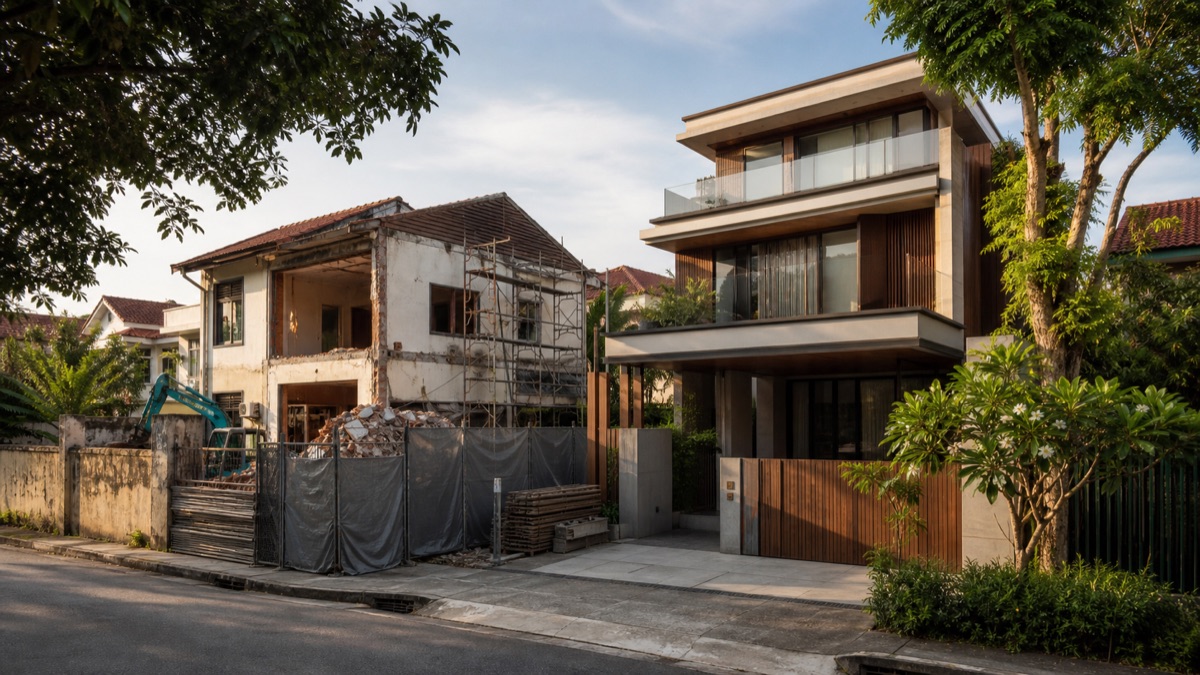
That question makes landed developers look like very expensive project managers. They buy an ageing house, replace it with something modern, then return to the market with a much larger price tag.
But how much of that gap is actually profit? The developer still has to fund the land, pay stamp duties, carry a more expensive loan, demolish the old house, manage the rebuild and sell within a deadline.
Let’s put one S$5 million project through the numbers. By the end, we’ll know how much of the premium pays for taking the redevelopment work and risk off your hands, and how much is really left as profit.
How the business works
Our example is a Singapore private limited company that buys an old landed home, demolishes it completely, builds a new one and sells it. A company developing 4 or fewer homes can operate as a non-licensed housing developer, provided it genuinely carries on housing development for sale.
The developer works backwards:
Expected selling price minus every project cost minus required profit equals the maximum land price.
That matters because the market doesn’t care how much the developer spent. If comparable new houses sell for S$10 million, adding marble floors won’t magically make buyers pay S$12 million.
Buying the S$5 million house
Both an individual and a developer pay the same Buyer’s Stamp Duty, or BSD. On a S$5 million residential property, that is S$239,600 under the current IRAS BSD rates.
Assume the individual is a Singapore citizen buying their first home. They pay no ABSD, while the developer pays a permanent 5% ABSD of S$250,000.
| Acquisition cost | SC first-home buyer | Landed developer |
|---|---|---|
| Purchase price | S$5,000,000 | S$5,000,000 |
| BSD | S$239,600 | S$239,600 |
| Permanent ABSD | S$0 | S$250,000 |
| Price plus permanent duties | S$5,239,600 | S$5,489,600 |
The developer’s additional permanent stamp-duty cost is therefore S$250,000. Meaningful, but not the millions one might expect after seeing the headline developer ABSD rate.
Why the developer needs more cash
An eligible first-home buyer may obtain up to 75% LTV, subject to TDSR, valuation, age, tenure and the bank’s approval. The developer’s land financing is negotiated, and I used 60% as a prudent first-project assumption.
| Purchase-day funding | Individual at 75% LTV | Developer at 60% financing |
|---|---|---|
| Loan | S$3,750,000 | S$3,000,000 |
| Purchase equity | S$1,250,000 | S$2,000,000 |
| BSD | S$239,600 | S$239,600 |
| Permanent ABSD | S$0 | S$250,000 |
| Cash before other fees | S$1,489,600 | S$2,489,600 |
The developer needs S$1 million more upfront. Of that, S$250,000 is additional tax and S$750,000 is extra equity because the land loan is smaller.
That S$750,000 isn’t an expense. The money remains invested in the project, but it can’t be used elsewhere until the house is sold.
Construction financing comes separately and is drawn progressively against certified work. Individuals can also obtain construction loans, with OCBC currently advertising financing of up to 75% of approved construction cost.
The difference comes after completion. An individual can convert the facility into a long-term home mortgage. The developer must sell the house and repay the project facility.
What happens to the 40% ABSD and SSD?
The headline developer ABSD is 40%, but it consists of 2 parts:
| Developer ABSD | Rate | S$5m property | Normal treatment |
|---|---|---|---|
| Non-remittable | 5% | S$250,000 | Paid permanently |
| Remittable | 35% | S$1,750,000 | Not normally paid |
The company applies for the 35% remission upfront. For a project of 4 or fewer homes, it must start qualifying work within 2 years, then complete and sell every home within 3 years of acquisition.
Meet the conditions and the S$1.75 million is never paid. Fail them and IRAS can claw it back with 5% annual interest running from 14 days after acquisition. The details are in the IRAS developer remission rules.
Seller’s Stamp Duty looks equally frightening. A property acquired on or after 4 July 2025 and sold after more than 2 but within 3 years would ordinarily attract 8% SSD.
However, a registered non-licensed developer carrying on housing development for sale may obtain SSD remission. It must be a genuine new build or complete demolition and reconstruction, not a partial rebuild dressed up for the paperwork.
The real cost of rebuilding
Here are the main assumptions in our illustrative model:
| Assumption | Base case |
|---|---|
| Purchase price | S$5,000,000 |
| Constructed floor area | 6,000 sq ft |
| Main construction cost | S$400 per sq ft |
| Construction contingency | 7.5% |
| Professional fees | 10% of main construction cost |
| Project period | 30 months |
| Developer interest rate | 4.75% a year |
| Sales commission | 2%, plus GST on commission |
Start with the 2 largest numbers. The old house costs S$5 million and the new house costs S$2.4 million to build, giving us S$7.4 million before everything else.
| Major cost contribution | Approximate cost |
|---|---|
| Buy the old house | S$5.00m |
| Main construction | S$2.40m |
| BSD, 5% ABSD and acquisition legal fees | S$0.52m |
| Demolition, contingency, consultants and approvals | S$0.61m |
| GST, property tax, administration and fixed selling costs | S$0.46m |
| Interest and loan fees | S$0.55m |
| Fixed project cost before agent commission | S$9.54m |
The S$0.61 million development bucket includes about S$240,000 of professional fees, S$180,000 of contingency and S$190,000 for demolition, approvals and site investigations. The next S$0.46 million includes roughly S$278,000 of unrecoverable GST, plus property tax, insurance, legal work and marketing.
Residential property sales are generally exempt from GST. But GST incurred on residential construction and professional expenses is generally not claimable, so it stays inside the project cost. IRAS explains the GST treatment here.
That gets the developer to S$9.54 million before paying the sales agent. At the break-even sale price, the 2% commission and GST add another S$213,000, taking the final break-even to approximately S$9.75 million.
The separate S$4.25 million equity figure is how much cash the developer must put in after using loans. Borrowing reduces the cash required, but it doesn’t reduce the project’s total cost.
How much must the new house sell for?
That is why our approximate break-even sale price is S$9.75 million. At S$10 million, the developer makes only around S$242,000 before corporate tax.
| Finished sale price | Approx. pre-tax profit | Profit on total cost |
|---|---|---|
| S$9.75m | Around break-even | 0% |
| S$10.00m | S$242,000 | 2.5% |
| S$10.50m | S$731,000 | 7.5% |
| S$11.00m | S$1,220,000 | 12.5% |
| S$11.25m | About S$1,470,000 | 15% |
| S$11.76m | About S$1,960,000 | 20% |
Property-development profit is business income. Singapore’s headline corporate income-tax rate is 17%, although exemptions, losses and rebates may change the effective amount. IRAS explains when developer income and costs are recognised.
So a S$5 million old house becoming an S$11 million new house doesn’t mean the developer pocketed S$6 million. Most of that gap disappeared before the buyer collected the keys.
Where the developer makes money
Paying full retail price for an ordinary one-for-one rebuild is often the weakest model. Successful landed developers create margin elsewhere:
- Buy correctly. If new-house comparables support only S$10 million, the old house must be acquired materially below S$5 million.
- Subdivide suitable land. One large site may become 2 semi-detached houses or several terraces, subject to URA rules.
- Use the site better. More usable space, better parking and the right room configuration can add more value than they cost.
- Build repeatedly. Regular consultants, contractors and suppliers reduce redesign, mistakes and expensive variations.
- Sell convenience. The finished-home buyer avoids approvals, construction delays, temporary accommodation and 2 years of contractor decisions.
Subdivision is highly site-specific. URA’s landed redevelopment guidelines show how plot dimensions, housing type and adjoining properties affect what is possible.
Market appreciation can rescue a mediocre project too. That’s nice when it happens, but it’s not a business model.
What this means for a landed buyer
A Singapore citizen buying their first home could generally rebuild the same property more cheaply. They avoid the developer’s 5% ABSD and profit margin, and may obtain cheaper personal financing.
But the buyer also assumes the approvals, construction variations, delays, defects and temporary accommodation. Buying from the developer is not the cheapest route under identical assumptions; it is the turnkey route.
And that is really what the landed developer sells: a finished house, a known price and freedom from becoming an accidental project manager.
Property rules, tax rates and financing terms change. Verify the current position with IRAS, URA, your conveyancing lawyer, tax adviser and lender before acting on these figures.
The excavator is the easy part. Buying the right land is the business.