
The key to finding your perfect property should be in your hands. We empower you with valuable insights & tools, and let you be in control of your home search.
Everything You Need to Know About Singapore Condo Floor Plans
How regulations shaped design, what changed decade by decade, and what to actually look for when comparing units.
Floor plans aren’t just rectangles with labels. They’re the product of decades of regulation changes, developer incentives, and design trends. A 1,000 sqft unit from 2005 and a 1,000 sqft unit from 2025 are completely different animals.
If you don’t understand why they’re different, you’ll overpay. Or worse, you’ll buy a unit where 8% of your “floor area” is an air-con ledge you’ll never stand on.
This page covers everything a Singapore property buyer needs to know about reading, comparing, and evaluating condo floor plans. From the 1980s to today.
TL;DR: The floor plan checklist
Short on time? Here’s what to check when reviewing any condo floor plan.
- Check the TOP year. Pre-2009? Watch for bay windows inflating the sqft. 2010s? Check for oversized AC ledges. Post-June 2023? Harmonized area, what you see is closer to what you get.
- Dumbbell or linear? Dumbbell (bedrooms on opposite ends) is more efficient. Linear layouts waste space on corridors.
- Measure the bedrooms. Common bedroom needs 2.8m width minimum for a queen bed. Master needs 3.2m for a king. If the floor plan doesn’t show dimensions, ask.
- Find the dead space. AC ledges, RC ledges, long corridors, bomb shelter. Add them up. If non-liveable space exceeds 8% of strata area, discount accordingly.
- Check the north arrow. West-facing gets brutal afternoon sun. East or north-facing is generally preferred in Singapore.
- Balcony depth. Under 1.5m? It’s a shelf, not a balcony.
- Kitchen layout. Open concept = smells everywhere. Enclosed or wet/dry split = practical for actual cooking.
- Structural columns. Dark squares on the plan. They can’t be removed. Check they don’t intrude into living spaces.
- Compare fairly. When comparing across eras, add 4% to harmonized area (post-2023) to match pre-2023 measurements. Subtract 3% for bay windows, 3-5% for excessive AC ledges.
Now for the full picture.
The regulations that shaped everything
Every weird design quirk in Singapore condos traces back to a URA rule. Here’s the timeline that matters.
Pre-2009: The bay window and planter box era
URA exempted bay windows and planter boxes from Gross Floor Area (GFA). The intention was good: encourage architectural variety and greenery in high-rise living.
What actually happened: developers went nuts. Over 50% of completed condo units between 2002 and 2013 had bay windows. Not because residents wanted them, but because they were “free” buildable area that didn’t count against the site’s plot ratio. Developers could sell this space to buyers without using up their GFA allowance.
Planter boxes were even worse. URA later found that less than 10% were actually used for plants. Most became mosquito breeding grounds or were illegally enclosed as living space.
Bay windows typically added 1.4% to 4.1% of strata area per unit. That’s space you paid full PSF for, but couldn’t really furnish properly. Ever tried putting a desk in a bay window alcove? Exactly.
2009: The first crackdown
1 January 2009: URA removed the GFA exemption for bay windows and planter boxes in all new residential developments (Circular dc08-17). Projects with existing Provisional Permission were grandfathered.
Bay windows disappeared almost overnight from new designs. By 2021, practically no new project included them.
URA’s stated reason: bay windows “increase heat transfer into buildings and increase air-conditioning load, making buildings less green.” Translation: they were never a good idea and everyone knew it.
2012-2018: Fighting shoebox apartments
The late 2000s saw a “strange trend” of shoebox units under 500 sqft flooding the market. Fort Suites had 3-bedrooms at 624 sqft. The Rise @ Oxley squeezed 3-bedders into 667 sqft. These weren’t studios. Three bedrooms.
URA responded:
- 2012: Maximum dwelling unit guideline introduced. Max units = GFA / 70 sqm. Targeted areas like Telok Kurau where shoebox proliferation was worst.
- 2018: Raised the divisor to 85 sqm. Nine areas (Marine Parade, Joo Chiat-Mountbatten, Telok Kurau, Balestier, Stevens-Chancery, and others) use an even stricter 100 sqm divisor.
- 2023: Added distribution requirements. At least 20% of units must have nett internal area of 100 sqm or more (outside Central Area). Maximum 20% of units can be under 50 sqm.
The effect: average new condo unit size stopped shrinking. It bottomed out at 858 sqft in 2015 and has since recovered to about 929 sqft by 2024.
2013: PES and roof terraces capped
Private Enclosed Spaces and roof terraces were another GFA loophole. Developers built massive outdoor spaces (cheaper to construct than indoor space) and sold them at near-indoor PSF rates.
From 2013, PES and private roof terraces count as bonus GFA, capped at 10% above the Master Plan allowance (shared with balconies).
2019: Balcony rules tightened
The Balcony Incentive Scheme launched in 2001 gave developers 10% bonus GFA for outdoor spaces. By 2019, URA reined it in:
- Bonus GFA cap reduced from 10% to 7%
- Each unit’s balcony area capped at 15% of nett internal area
- Minimum balcony width of 1.5m (previously no minimum, which led to “balconies” that were basically oversized planters)
2023: GFA harmonization (the big one)
1 June 2023. The single most important regulatory change in decades.
Four agencies (URA, SLA, BCA, SCDF) aligned their floor area definitions. Before this, different agencies measured differently, creating gaps that developers exploited.
What changed:
- All strata area now counts as GFA. No more “free” area that developers could sell without it counting against plot ratio.
- Voids excluded from strata area. Developers can no longer charge buyers for empty air. A unit with a double-volume living room previously had the void counted in its sqft. Now it doesn’t.
- AC ledges: If included as strata area (owned by buyer), they count as GFA. Developers can make them common property instead (maintained by MCST, not charged to buyer) to exclude them from GFA, up to 2m width.
- Measurements standardized to middle of wall. Previously URA measured to full external wall thickness.
The practical impact: about a 5% reduction in total saleable area for a typical condo. Higher PSF on paper, but more honest. A 900 sqft unit under new rules has more liveable space than an old 900 sqft unit.
When comparing a post-June 2023 unit against a pre-2023 unit, add about 4% to the harmonized area to get an apples-to-apples comparison.
How condo designs changed, decade by decade
1980s-1990s: The spacious era
Early condos were built for wealthy buyers. 3-bedroom units routinely hit 1,700 to 1,800 sqft. Separate living and dining areas. Servant entrances. Dressing corners in the master bedroom. Some had two side-by-side bathrooms with separate bathtubs.
Average new condo size in 1995: 1,272 sqft.
These units feel palatial by today’s standards. The trade-off: facilities were basic (a pool, maybe a tennis court), and layouts were often linear with long corridors connecting rooms.
2000s: Bay windows, planter boxes, and the first shoeboxes
The GFA loophole era. Developers stuffed every unit with bay windows and planter boxes to maximize saleable area. Open kitchens and minimal hallways became popular.
Average new condo size in 2005: 1,286 sqft. Still reasonable, but the floor plans were increasingly padded with non-liveable space.
By the late 2000s, shoeboxes started appearing. Studios under 400 sqft. “1-bedrooms” that were really studios with a partition. The market was chasing yield, not liveability.
2010s: The AC ledge era
With bay windows and planter boxes gone from GFA exemptions, developers needed a new trick. Enter: oversized air-con ledges.
AC ledges weren’t counted in GFA but were part of strata area. Developers built them as large as possible. La Fiesta in Sengkang is the poster child: AC ledges almost 5m long, taking up 9 sqm per unit. That’s nearly the size of a bedroom.
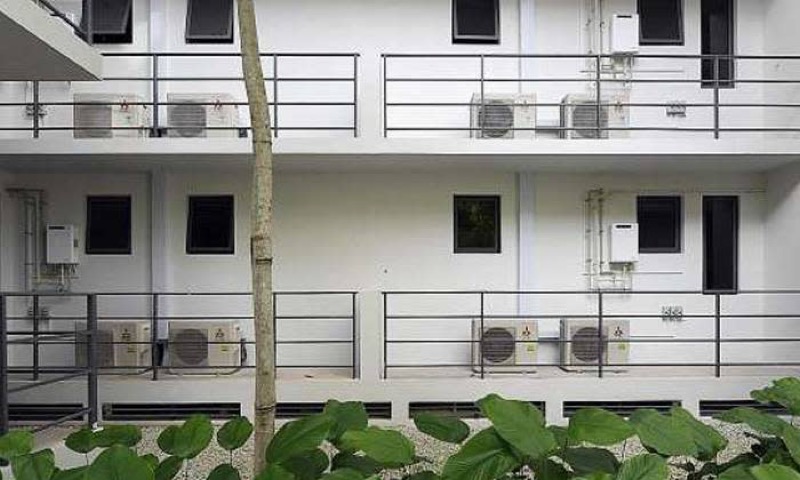
La Fiesta's oversized AC ledges. You're paying for this space. You'll never use it.
Across the industry, AC ledges consumed 4-5% of total saleable area on average. Private property buyers were paying an estimated $780 million per year collectively for AC ledges alone.
This decade also saw the rise of PPVC (Prefabricated Prefinished Volumetric Construction). Entire rooms built in a factory and stacked on site. Faster construction (7 days per floor vs 14-21 conventional), but constrained design. PPVC units typically have 2.75m ceiling heights and room widths capped at 2.8m.
3-bedroom sizes contracted hard. The 1980s standard of 1,700+ sqft shrank to 1,000-1,200 sqft by the late 2010s.
2020s: Post-harmonization efficiency
GFA harmonization killed the last major loophole. Developers can’t inflate area with voids, AC ledges, or curtain walls anymore. Every square foot has to justify itself.
The result: dumbbell layouts dominate. Bedrooms on opposite ends of the unit, living space in the middle. No wasted corridor connecting a string of rooms. More efficient, more liveable.
Other trends:
- Flexi rooms and modular designs for customization
- Private lift lobbies in premium developments
- Smart storage: built-in shelving, under-bed compartments
- Enclosed or semi-enclosed kitchens making a comeback (open concepts turned out to be a bad idea for serious Asian cooking)
- High ceilings reviving since void spaces no longer count in strata area. Developers can offer double-volume living rooms without penalizing the buyer on PSF
Modern 3-bedrooms sit around 1,000 to 1,200 sqft. Smaller than the 1990s, but with far less wasted space.
The bomb shelter nobody talks about
Every new condo unit in Singapore has a household shelter. It’s been mandatory since 1 May 1998, a response to the Gulf War.
Specs: maximum internal area of 4.8 sqm, minimum clear height of 2.5m, reinforced walls and ceiling, airtight door. In practice, most people use it as a storeroom.
In a 500 sqft studio, that 4.8 sqm shelter takes up nearly 10% of your floor area. In a 1,200 sqft 3-bedder, it’s more like 4%. Either way, it’s dead space that you can’t reconfigure. Something to factor in when comparing against older units that don’t have one.
If you’re looking at a pre-1998 condo, the absence of a bomb shelter means you’re getting slightly more usable space per square foot. Small thing, but it adds up.
What to actually look for
Dumbbell vs linear layout
Dumbbell: Bedrooms on opposite sides, living area in the middle. The connecting space doubles as your living room. Minimal wasted corridor. This is what most modern condos use and it’s the more efficient layout.
Linear: Rooms stacked along one side, connected by a walkway. Common in older condos and smaller units. More privacy (the master bedroom is further from common areas), but the corridor eats into your usable space.
If two units are the same size but one is dumbbell and the other linear, the dumbbell unit will feel 5-10% bigger.
Bedroom sizes
What’s typical now vs what it used to be:
| 1990s | 2020s | |
|---|---|---|
| Master bedroom | 180-220 sqft | 120-160 sqft |
| Common bedroom | 120-150 sqft | 60-100 sqft |
For a common bedroom, you need at least 2.8m width to fit a queen bed with walkway clearance on both sides. Below that, you’re looking at a single bed room regardless of what the developer calls it.
Master bedroom needs 3.2m width minimum for a king bed plus nightstands.
If the floor plan doesn’t show dimensions, that’s a red flag. Ask for them.
Kitchen: open vs enclosed
Open concept kitchens dominated the 2000s and 2010s. They make the unit feel bigger. They also fill your living room with the smell of fried sambal.
The trend has shifted back to enclosed or semi-enclosed kitchens, especially in 3-bedders and above. Wet/dry kitchen splits (heavy cooking in the enclosed wet kitchen, a dry kitchen counter integrated with the living area) are now standard in larger units.
If you’re comparing a 2010s open-kitchen unit against a 2020s enclosed-kitchen unit of the same size, the 2020s unit will have slightly less visual openness but way more practical functionality.
Ceiling heights
| Era | Typical height |
|---|---|
| 1980s-1990s condos | 2.8-3.0m |
| 2010s condos | 2.8m |
| PPVC condos | 2.75m (living), 2.35m (kitchen/bath) |
| HDB flats | 2.6m |
PPVC construction limits ceiling height because of modular constraints. If you’re looking at a new launch built with PPVC, expect 2.75m in bedrooms and living areas. Not bad, but noticeably lower than the 3.0m ceilings in some older luxury projects.
Balcony: bonus or waste?
Post-2019 rules: balcony must be at least 1.5m deep and can’t exceed 15% of the unit’s nett internal area. Before that, developers could build token balconies that were too shallow to actually use.
A 1.5m deep balcony fits a small table and 2 chairs. Anything less is a shelf with a view. Check the depth on the floor plan. If it’s 1.2m, you’re not having breakfast out there.
The comparison checklist
When comparing 2 units side by side, here’s what to adjust for:
| Factor | How to adjust |
|---|---|
| Harmonized vs pre-harmonized | Add 4% to harmonized area |
| Bay windows (pre-2009 units) | Discount 3% from strata area |
| Excessive AC ledges | Discount 3-5% from strata area |
| Long corridor layout | Discount 2-3% for inefficiency |
| Bomb shelter (post-1998) | ~4.8 sqm of non-configurable space |
| PPVC construction | Lower ceilings (2.75m vs 2.8-3.0m) |
| Balcony depth < 1.5m | Largely unusable outdoor space |
Two units listed at the same PSF could have very different effective costs once you account for these factors. The developer’s brochure won’t do this math for you.
Developer tricks to watch for
Show flat furniture. Custom-made, undersized pieces. The queen bed in the show flat might be 10% smaller than a real queen. The sofa is thinner. Everything is designed to make the room feel bigger than it is. Always cross-check with the floor plan dimensions.
No scale bar on floor plans. If the brochure floor plan doesn’t include a scale bar or dimensions, request them. Some developers deliberately omit these.
Wide-angle photography. Show flat photos use ultra-wide lenses that distort proportions. A room that looks spacious in the photo might be 80 sqft in reality.
Void area pricing (pre-2023). In older projects, developers charged 30-50% of PSF for void space (double-volume ceilings). You were paying for air. Post-harmonization, voids are excluded from strata area, so this trick is dead for new launches. But resale units from the 2010s might still have inflated strata areas because of this.
How to read a floor plan
A few practical things most guides skip:
- North arrow. Find it. West-facing units get brutal afternoon sun in Singapore. East or north-facing is generally preferred.
- Door swing arcs show which way doors open. A door that swings into a room eats into useable wall space.
- Thick walls around a small room usually mean it’s the bomb shelter.
- Dotted lines typically indicate overhead features or void areas.
- Dark filled squares are structural columns. They can’t be removed during renovation. Check if any columns intrude into living spaces.
- 1:100 scale is standard. 1cm on paper = 1m in real life. Measure with a ruler if dimensions aren’t printed.
The big picture
Singapore condos have gotten smaller. That’s not going to reverse. Land is expensive, plot ratios are capped, and developers need to hit price points that buyers can afford.
But they’ve also gotten more honest. GFA harmonization means what you see is closer to what you get. The era of padded strata areas, phantom voids, and 9 sqm air-con ledges is over.
The catch is that older resale units still carry those quirks. If you’re comparing a 2025 new launch against a 2015 resale, you’re comparing two completely different measurement systems. Without adjusting for that, you’re making a decision on bad data.
Now you know what to adjust for.