Freehold vs Leasehold Condos: How Much Extra Is Worth Paying?
I have 2 children, and their future matters to me. But I don’t feel I need to leave them a property or an inheritance. I want them to be independent.
For the 丁克一族, or dual-income couples without children, paying extra to pass a condo to their children may have little relevance either.
If I were super wealthy, I’d give more thought to what I should leave behind. Otherwise, I don’t see why my housing budget needs to stretch to a legacy. A fresh 99-year lease is already plenty for my own lifetime.
I’d rather spend the money on living. But I can still see the appeal of freehold at a small premium. It depends on how much you’re paying for the extra tenure, and what you want from it.
Why people pay for freehold
Freehold has no fixed lease expiry. You can hold it without the remaining tenure shrinking, then pass it to your children.
For buyers who want that flexibility, the premium buys something useful. Some simply sleep better owning freehold. Fair enough.
A 99-year lease runs from its commencement date, which can be years before the condo’s TOP. A 999-year lease is still leasehold, though expiry is much further away.
Freehold doesn’t keep the building young. Maintenance costs, MCST decisions and the possibility of a collective sale still apply.
The land tenure can outlast the building. The lifts still need replacing.
For State leases, SLA generally allows expiry without renewal. Renewal is discretionary and, if approved, requires a land premium. Don’t buy on the assumption that an en bloc sale will rescue a short lease.
The price gap has narrowed, but 7.1% needs context
ERA’s September 2026 analysis reported a new-sale price gap of 48.2% in Q1 2020, falling to 7.1% across January to August 2026. In that latter period, median prices were $2,724 psf for freehold and $2,544 psf for 99-year leasehold.
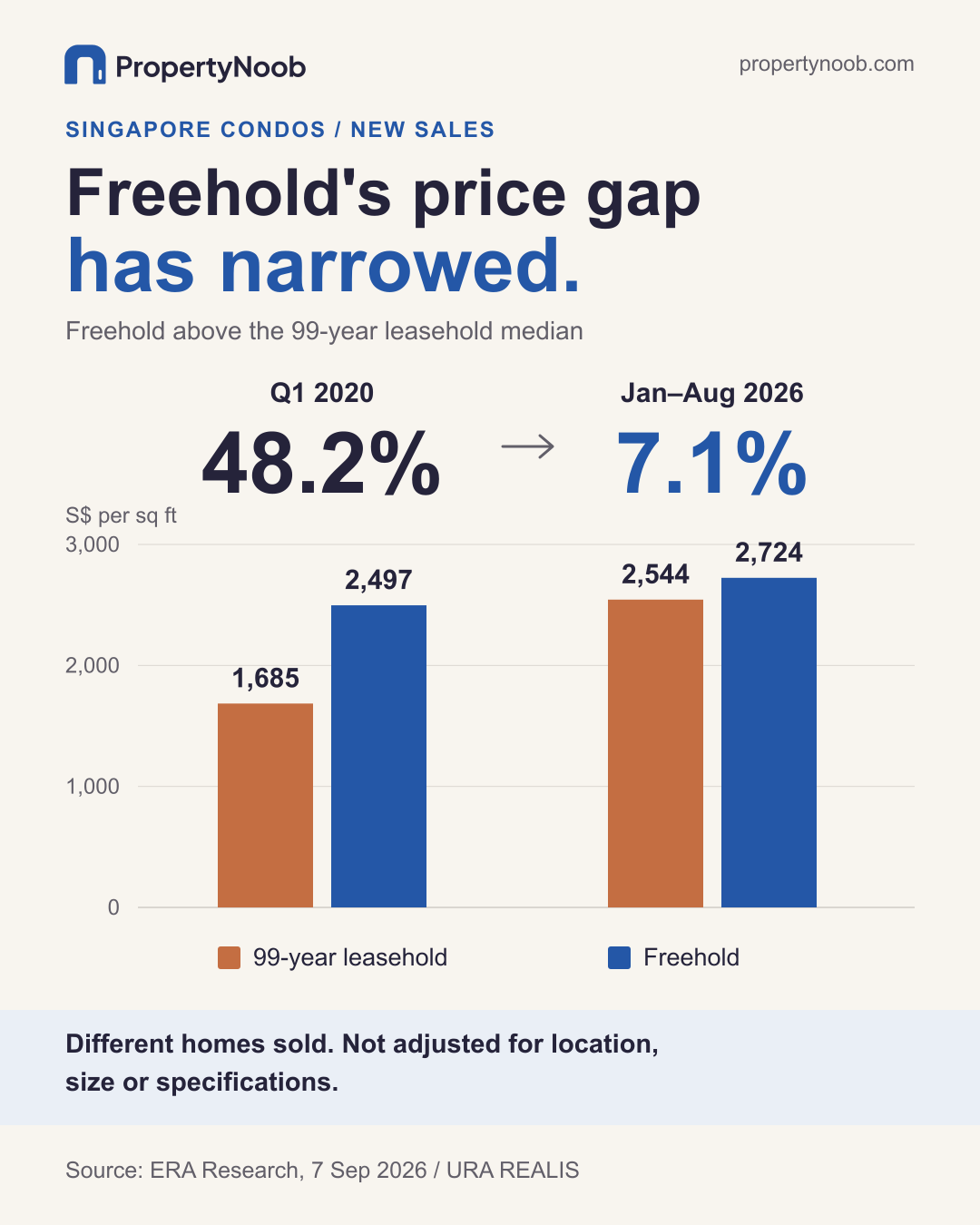
These are different groups of homes sold. They aren’t matched on location, MRT access, size, floor or specifications. More expensive leasehold launches, or a different mix of freehold projects, can narrow the gap without the same change in what buyers pay for tenure alone. It also tells us nothing about the gap for resale condos.
The smaller observed gap gives buyers a reason to reconsider freehold. It doesn’t establish that an otherwise identical freehold home should cost exactly 7.1% more.
For comparison, NUS research published in 2021 used 1995 to 2015 condo sales and controlled for characteristics including neighbourhood, floor space and storey. Its historical benchmark was 15% to 20% more for freehold than 99-year leasehold, and 3% to 5% more than 999-year leasehold.
That’s a different method and period from ERA’s medians. Neither percentage values the particular home you’re considering today.
What premium would I pay?
Suppose a leasehold home costs $2 million. A comparable freehold condo at $2.14 million costs $140,000 more, a 7% premium. At $2.3 million, the premium is $300,000, or 15%.
That’s $160,000 less to pay for the longer tenure at the smaller premium. Freehold could be more attractive at that price, provided you aren’t sacrificing location, usable space or building condition. These are hypothetical prices, separate from ERA’s 7.1% median gap.
For comparable homes with a long remaining lease, I’d investigate a single-digit freehold premium seriously. At 10% to 20%, I’d want recent transactions supporting the gap and a clear reason to pay it. Above 20%, I’d need stronger evidence than the word “freehold” in the listing. These are buying filters, not measured market bands.
Compare completed transactions from the same period, with similar unit sizes, ages and locations. Check total prices as well as PSF. Our new-launch versus resale guide explains why a newer leasehold home can cost more than an older freehold one.
Freehold doesn’t guarantee better returns
If you buy at a 15% premium and sell at the same premium, you get the same percentage price growth as the leasehold alternative. If prices rise, your dollar gain is larger because you invested more. If the premium narrows during your ownership, it dilutes your return.
ERA’s 2025 resale study found a narrowing gap in median dollar profits. But it examined profitable exits around selected MRT stations and excluded costs such as stamp duty and legal fees. It can’t establish which tenure had a lower chance of loss or higher net annualised returns.
Rent gives you another useful test. If our $2 million leasehold and $2.3 million freehold homes both rent for $5,000 a month, their gross yields are 3.00% and 2.61%. The freehold home needs $5,750 a month to match the cheaper unit’s yield.
Those figures exclude vacancy, tax, maintenance and financing. Check rental evidence rather than assuming tenants will pay more for your longer tenure.
Check the lease your next buyer will get
A leasehold condo can rise in price while its lease shrinks. Market growth can outweigh the tenure drag for years. But your eventual buyer still has to finance it.
Buy with 90 years left and sell after 10, and you offer 80 years. Buy with 65 and hold for 20, and you offer 45. Those need different exit assumptions.
CPF usage is pro-rated if the lease doesn’t cover the youngest buyer to age 95; other withdrawal limits still apply. The property must have more than 20 years remaining for CPF use.
Banks have separate requirements. Citibank requires 30 years of lease remaining at the end of a private-property loan. Under that condition, a home with 45 years left allows at most a 15-year loan, before other eligibility limits. A shorter loan means higher monthly repayments for the same borrowing.
Which suits you?
Freehold makes more sense if you want a home for decades or a family asset to pass on, and the premium leaves your financial buffer intact. At a small price gap, I’d give it serious consideration. I’d still read the MCST accounts.
Leasehold can be the better buy if it gets you a better location or more usable space, offers stronger rental yield, and has ample tenure for your hold and the next buyer. For a planned 5 to 10-year ownership, entry price, competing supply and resale activity deserve close attention.
An older leasehold home can suit an older buyer’s housing needs at a lower price. Price the eventual resale risk separately: a younger buyer may face different CPF and borrowing constraints.